How to Make Your Own Watercolors from Pigments and Earths
As I wrote in my page, if you are here, it’s because probably something tickled your interest or searching for info or… you are crazy like me!
Are you a watercolor lover who wants to experiment with different colors and techniques? Do you want to create your own watercolors from scratch using natural pigments and earths? If so, this article is for you.
In this article, I will show you how I make my own watercolors from pure pigments and binders. I will also share with you how I harvest earths from different places and turn them into unique colors. You will learn how to make watercolor pans and tubes of the highest quality possible, with maximum brightness, luminosity, and hue.
What You Need to Make Your Own Watercolors
To make your own watercolors, you will need the following materials:
- Pigments: These are the substances that give color to your watercolors. You can buy them online or in art stores, or you can make them yourself from natural sources. Some examples of pigments are ultramarine, ochre, sienna, indigo, etc.
- Binder: This is the substance that holds the pigment particles together and makes them adhere to the paper. The most common binder for watercolors is arabic gum, which is a natural resin extracted from acacia trees. You can also use honey or glycerin as additives to make the binder more fluid and moist. A drop of clove oil can help prevent mold growth.
- Water: This is the solvent that dissolves the binder and allows you to mix and apply the watercolors. You can use tap water or distilled water, depending on your preference.
- Pans or tubes: These are the containers where you store your watercolors. Pans are small plastic or metal trays that hold solid watercolors. Tubes are metal or plastic cylinders that hold liquid watercolors. You can buy empty pans or tubes online or in art stores, or you can reuse old ones.
- Palette knife: This is a tool that helps you mix and spread the watercolors on the pans or tubes. You can use any flat metal or plastic blade, such as a butter knife or a spatula.
- Mortar and pestle: This is a tool that helps you grind and mull the pigments and binders into a smooth paste. You can use any ceramic, glass, or metal bowl and stick, or you can buy a specialized one online or in art stores.
- Scale: This is a tool that helps you measure the proportions of pigments and binders. You can use any digital or analog scale that can measure grams or ounces.
How to Make Your Own Watercolors from Pigments
The process of making your own watercolors from pigments is simple and fun. Here are the steps to follow:
- Choose your pigment and measure it with a scale. The amount of pigment you need depends on how much watercolor you want to make and how intense you want the color to be. A general rule of thumb is to use 2 parts of pigment for 1 part of binder by weight or 1 part of pigment and 3 parts of binder. I usually do the latter.
- Add some water to your pigment and mix it well with a palette knife until you get a thick paste. This will help dissolve the pigment particles and make them easier to mull.
- Transfer the paste to a mulling slab or glass and add some binder. The amount of binder you need depends on the type of pigment you are using and how fluid you want your watercolor to be. A general rule of thumb is to use 1 part of binder for 2 parts of pigment by weight or 1 part of pigment and 3 parts of binder. I usually do the latter but experience will tell you. Some pigments require more binder some less: Experience and careful observation will tell you how much binder you may want to add.
- Mull the paste with a glass muller until you get a smooth and homogeneous mixture. This will help disperse the pigment particles evenly and create a fine texture for your watercolor. You may need to add more water or binder as you mull, depending on the consistency of your paste. This process my take up to 3 hours, depending on the pigment and the consistency you may need. Usually I don’t go for less than one hour with any pigment: this allows me to have a fine and rich color.
- Fill your pans or tubes with your watercolor mixture using a palette knife or a syringe. Make sure to leave some space at the top for expansion and drying.
- Let your watercolor dry completely before using it. This may take several days or weeks, depending on the humidity and temperature of your environment. You can speed up the process by placing your pans or tubes in a warm and dry place, such as an oven or a dehydrator.
- Enjoy your homemade colors and start making art!
How to Make Your Own Watercolors from Earths
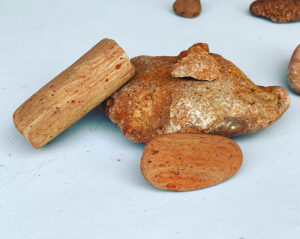
Another way to make your own watercolors is to use earths as pigments. Earths are natural minerals that have different colors depending on their composition and origin. Some examples of earths are clay, sand, soil, rock, etc.
You can harvest earths from different places and turn them into unique colors that reflect your memories and experiences. Here are some tips on how to do that:
- Look for earths that have interesting colors and textures in places that are meaningful to you. For example, you can collect sand from a beach where you spent your vacation, soil from a garden where you grew your flowers, rock from a mountain where you hiked, etc.
- Make sure to ask for permission before taking any earths from private or protected areas. Also, be respectful of the environment and only take small amounts that will not harm the ecosystem.
- Clean and dry your earths before using them as pigments. You can wash them with water and soap to remove any dirt or organic matter, and then let them dry in the sun or in an oven.
- Grind your earths into fine powders using a mortar and pestle or a blender. You can also sift them through a sieve or a cloth to remove any large particles or impurities.
- Follow the same steps as above to make your watercolors from earths. You may need to adjust the proportions of water and binder depending on the type of earth you are using and how it reacts with them. Experience will tell, usually earth are thirsty!
Why You Should Make Your Own Watercolors
Making your own watercolors from pigments and earths has many benefits, such as:
- You can create custom colors that suit your style and preferences. You can also experiment with different combinations and effects to achieve unique results.
- You can save money by using natural and inexpensive materials that you can find or make yourself. You can also reuse old pans or tubes to store your watercolors.
- You can have fun and express your creativity by making your own watercolors. You can also share your process and products with others and inspire them to do the same.
- You can contribute to the sustainability of the planet by using local and organic materials that do not harm the environment. You can also reduce waste by making only what you need and using what you have.
I hope this article has inspired you to make your own watercolors from pigments and earths. If you have any questions or comments, feel free to contact me.
Need to buy some pigments?
This is my favorite pigments dealer in Europe. And probably the best.
I would love to hear from you and see your creations!